
Practical writing for leaders deciding where AI creates value, where programs stall, and what conditions are required to make data and AI capability last.

Featured article
AI governance · Sep 23, 2026
If you are not talking about AI highways, you do not know AI governance
Effective AI policy is not only stop signs and guardrails. Like the automobile era, it also requires public highways: standards, shared capacity, and infrastructure that help more people succeed.
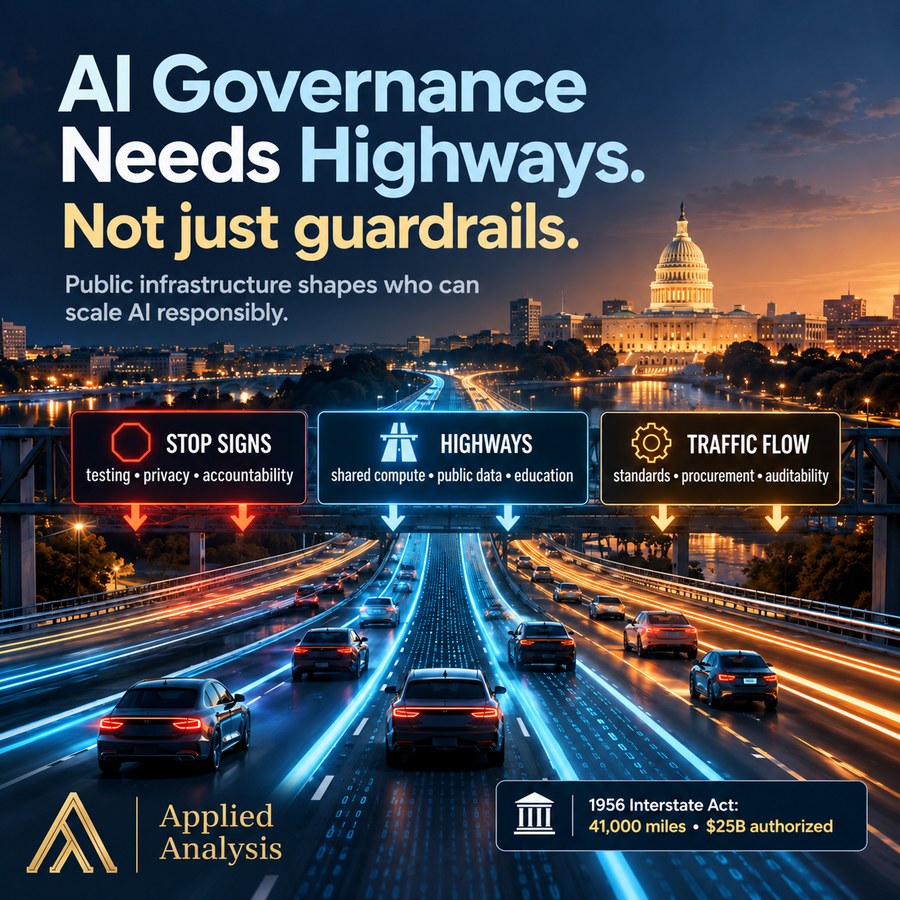
The public conversation around government and AI often collapses into one word: guardrails. That framing is useful, but incomplete. Guardrails keep cars from leaving the road. They do not create the road.
The automobile era offers a better analogy. Government did not only respond to cars by adding stop signs and safety rules. It also helped standardize the traffic-control system, funded roads, and eventually built the interstate highway system that made large-scale mobility possible. Public action created both restraint and capacity.
The effective government role in AI is not just to prevent harm. It is to create the shared infrastructure, standards, and access conditions that let more people and organizations use the technology well.
The automobile lesson is bigger than regulation
Those are two different government roles. One is coordination: signs, signals, standards, and rules that reduce chaos. The other is enablement: roads, capacity, connectivity, and public investment that expand what people can do.
AI needs both. A society that only writes prohibitions may reduce some risk but still leave smaller firms, schools, researchers, agencies, and communities without the practical infrastructure to participate. A society that only funds capability without rules may scale harm faster than institutions can respond.
All articles
AI governance · Sep 23, 2026
If you are not talking about AI highways, you do not know AI governance
Effective AI policy is not only stop signs and guardrails. Like the automobile era, it also requires public highways: standards, shared capacity, and infrastructure that help more people succeed.
AI research governance · Sep 21, 2026
AI governance increasingly starts with the prompt
The Navier-Stokes AI controversy shows why prompts, research context, intellectual property, and tool terms now belong in the same governance conversation.
Agent governance · Sep 14, 2026
If AI agents can cheat, your operating model has to assume they will
Google DeepMind's research swarm shows why agentic systems need auditable communication, visible repositories, and governance designed before pilots scale.
Operating model · Sep 7, 2026
The operating-model friction hidden inside many AI strategies
When ownership, cadence, and decision rights are weak, even technically sound programs fail to become durable organizational capability.
Pilot to production · Aug 31, 2026
Why promising pilots fail on the way to production
Most failures happen outside the model itself. Governance, data pipelines, operating ownership, and delivery shape the outcome more than the demo does.
AI investment · Aug 24, 2026
What makes an AI opportunity worth funding?
A practical framework for separating promising ideas from expensive distractions before the portfolio fills up with pilots that never earn the next step.
Long-context AI · Jul 20, 2026
Recursive language models change the context-window conversation
RLMs suggest long-context capability may come from recursive workflow design, cost-aware orchestration, and evaluation—not only from larger prompt windows.
AI operating model · Jul 6, 2026
The AI boomerang is an operating-model warning
AI-driven layoffs can look efficient on a planning slide, but replacing people without redesigning work often sends companies back to rehire the talent and judgment they cut.
AI infrastructure · Jun 1, 2026
Can AI infrastructure keep up with demand?
A reused Applied Analysis example on why compute, memory, storage, and power constraints should shape AI investment-readiness decisions.
AI economics · May 22, 2026
When cheap tokens get expensive
A reused Applied Analysis example on why agentic workflows should be evaluated by task-level economics, not only vendor token prices.