
AI infrastructure
AI infrastructure is easy to discuss as if it were only a compute story. In practice, it is also a memory story, a storage story, a datacenter buildout story, and a power story.
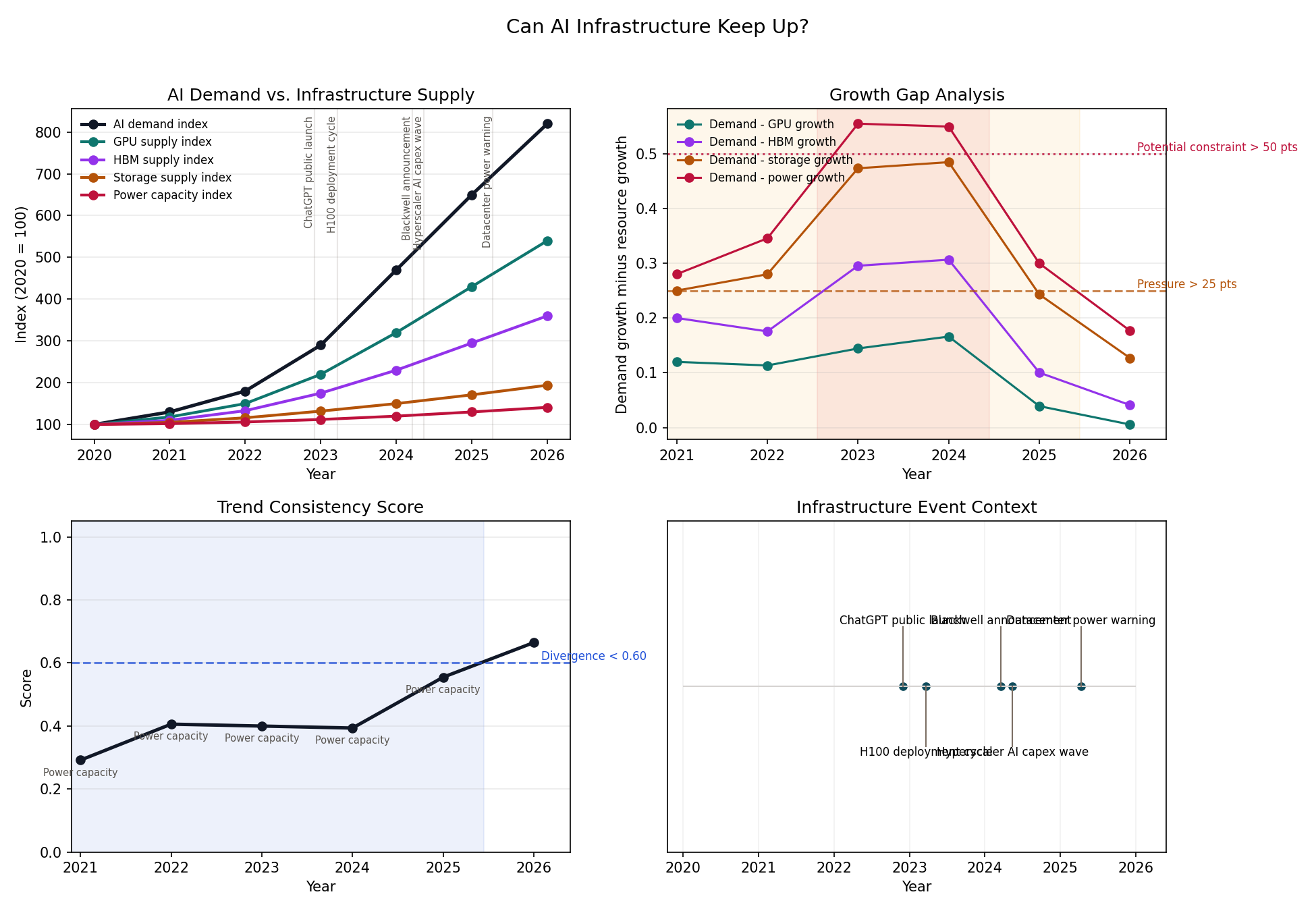
This Applied Analysis example asks a simple question: can AI infrastructure keep up with growing AI demand?
What the signals mean
The analysis compares one demand signal with four infrastructure supply signals:
- AI demand index;
- GPU supply index;
- HBM supply index;
- storage supply index; and
- power capacity index.
All of the series are indexed to a common baseline so the comparison stays readable across very different underlying units.
What is happening
At the broadest level, every line in the chart moves up. A simple direction-only comparison would say the system is moving together.
But direction is not the most useful signal here. The infrastructure question is whether demand is rising faster than the resources required to support it. In this example, compute supply grows quickly, but memory and especially power lag enough to create meaningful pressure windows.
Why consistency matters
Systems can look aligned at the headline level while still developing bottlenecks underneath. A consistency score helps identify when growth across related signals starts to look internally uneven rather than mutually reinforcing.
The clearest descriptive conclusion is not that AI infrastructure is absent. It is that future constraints may emerge less from raw compute alone and more from power and memory scaling.
Source: adapted from the Applied Analysis example repo post “Can AI Infrastructure Keep Up? Compute, Memory, Storage, and Power Under Pressure.”