
Long-context AI
The current AI conversation often treats context length like a bigger container problem: max out the window, compress the prompt, optimize memory, and hope the model can still reason over what matters.
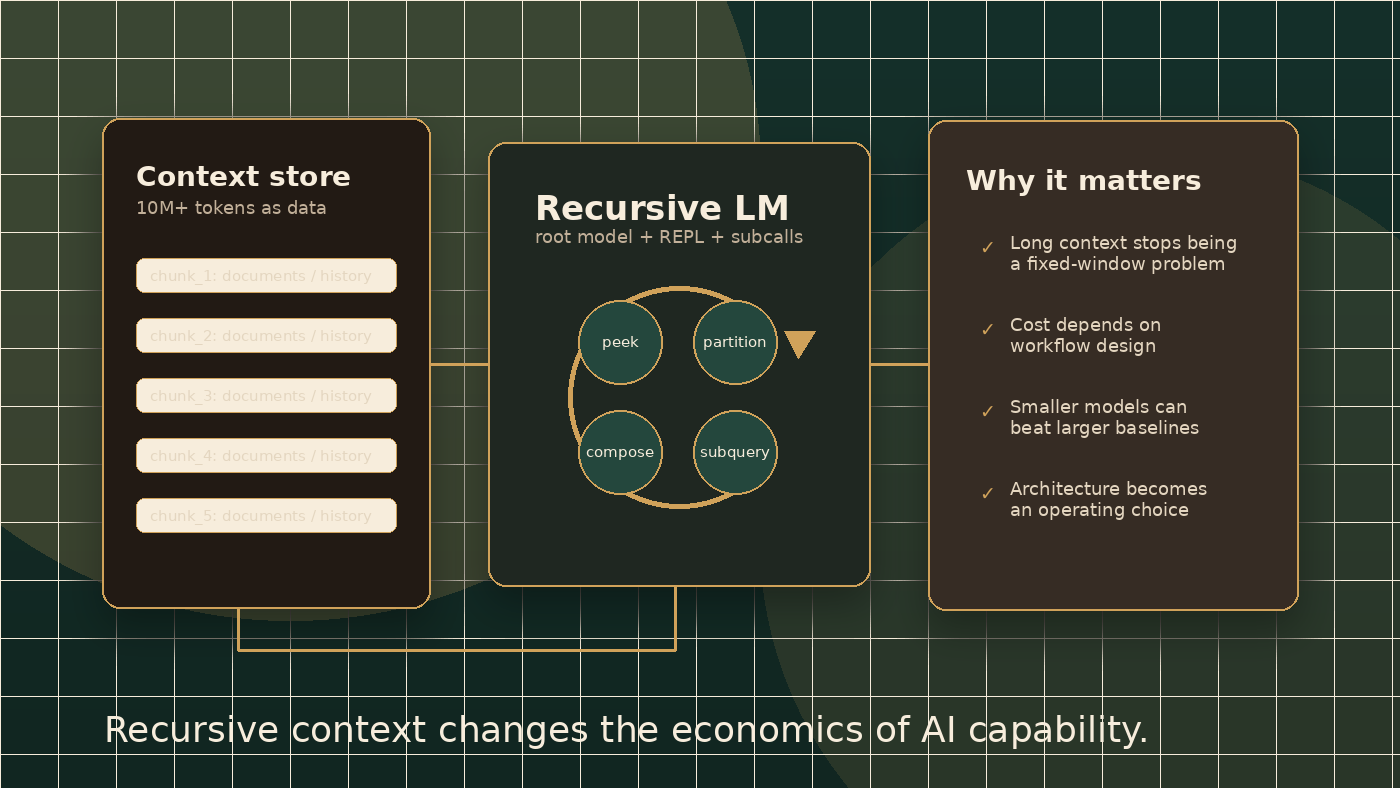
The Recursive Language Models work from Alex Zhang and Omar Khattab points to a different framing. Instead of forcing one model call to swallow the full context, an RLM lets a model interact with a context environment, inspect pieces of it, and recursively call language models over selected subproblems before producing a final answer.
That is a subtle but important shift. Long context stops being only a model-capacity question. It becomes a workflow design question.
Recursive Language Models are presented as “a general inference strategy where language models can decompose and recursively interact with their input context as a variable.”
The headline result is attention-grabbing: on a split of the OOLONG long-context benchmark, the authors report that an RLM using GPT-5-mini outperformed GPT-5 by more than double the number of correct answers while staying near the same cost per query on the 132k-token setting. They also report that RLMs kept working on much larger context settings, including experiments involving 10M+ tokens in a deep-research task.
The executive lesson is not “buy a longer context window”
Longer windows will help. But the paper’s more useful implication is that the organization should not assume the best AI architecture is always one very large model call. The stronger pattern may be an orchestrated process where the system decides what to inspect, what to summarize, what to recurse over, and when it has enough evidence to answer.
The model does not need every token in its immediate prompt if it can inspect, partition, and query context through a controlled environment.
The economics depend on how many calls are made, which model handles each layer, and how much context each step actually needs.
Teams need to test the full workflow, not just the base model, because decomposition and recursion can materially change quality and cost.
What this changes for AI leaders
For leaders funding AI programs, RLMs are a reminder that model selection is not the whole decision. The operating pattern around the model can change the capability frontier.
The practical questions become:
- Which tasks truly need long-context reasoning rather than retrieval, summarization, or simpler workflow design?
- Where does the system decide what context to inspect, chunk, recurse over, or ignore?
- How is cost measured at the completed-task level rather than the single-call level?
- What traces are available to audit the recursive path that produced an answer?
- Who owns the production pattern when a smaller model plus orchestration beats a larger direct call?
This is where the result connects directly to applied AI strategy. If long-context capability is going to be delivered through recursive workflows, then architecture, evaluation, governance, and operating ownership matter as much as the headline model name.
For Applied Analysis clients, the opportunity is not to chase every new inference pattern. It is to identify where these patterns change a real business workflow, then design the evaluation and operating model tightly enough to know whether the improvement is durable.
Source: Alex Zhang and Omar Khattab, “Recursive Language Models,” published Oct. 15, 2025.