
AI operating model
The conversation around AI often starts with replacement: which jobs can be automated, which teams can be reduced, and which costs can be taken out fastest.
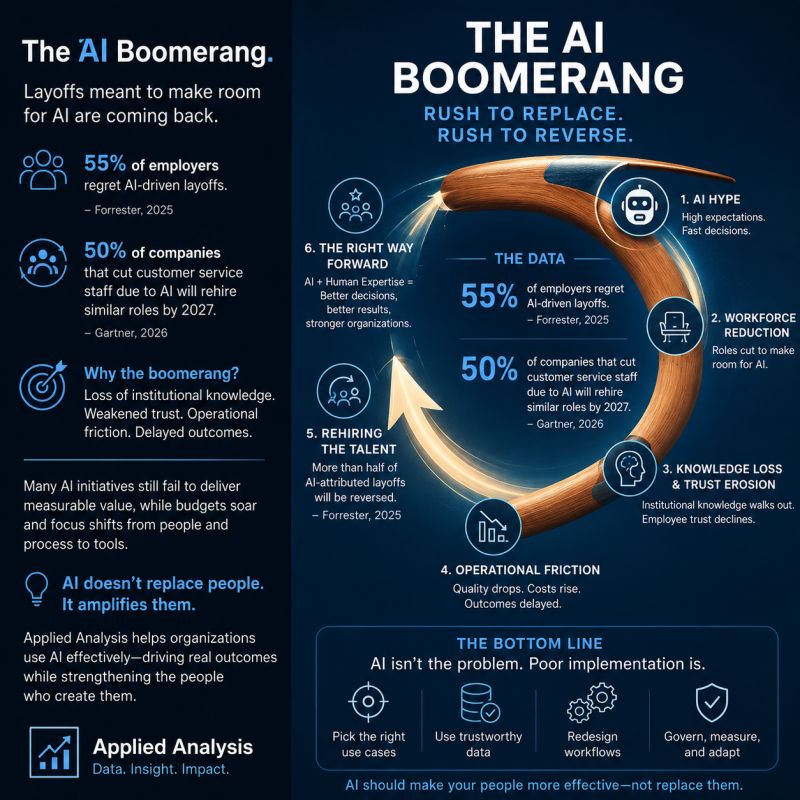
The more useful question is what happens afterward. I think of that pattern as the “AI boomerang”: layoffs meant to make room for AI come back around when organizations realize that headcount reduction did not redesign the work.
The point is not that AI is ineffective. The point is that replacing people is not the same as building a better operating system.
“The objective has never been to replace humans; it is to empower them to be significantly more effective.”
Two signals should make leaders pause: 55% of employers regret AI-driven layoffs, and Gartner forecasts that by 2027 half of organizations that cut customer-service roles because of AI will rehire similar positions. Whether those exact numbers move over time, the pattern is already familiar. AI programs create durable value when they redesign decisions, workflows, data, governance, and adoption—not when they simply remove experienced people and hope the tool fills the gap.
What leaves when experienced people leave
When experienced employees depart, the organization loses more than capacity. It often loses context that was never fully documented.
Teams carry history about why processes work the way they do, where exceptions live, and which tradeoffs have already been tested.
Experienced people know the edge cases, relationship dynamics, and judgment calls that clean process maps often miss.
AI changes work through people. If the workforce experiences AI as a threat, the implementation starts with weakened trust.
The implementation problem is bigger than the tool
Many organizations are spending heavily on AI platforms while struggling to show measurable business value. The technology is moving quickly, but the hard work is still operational:
- choosing the right use cases;
- preparing trustworthy data;
- redesigning workflows around human and AI strengths;
- establishing governance and measurement; and
- helping teams adopt a different way of working.
That is why the “AI boomerang” is really an operating-model warning. If the business case depends mainly on labor removal, the organization may miss the conditions that make AI valuable in the first place.
For leaders, the better question is not “How do we eliminate people?” It is “How do we enable our people to do what only humans can do, while using AI to remove friction around them?”