
AI governance and public infrastructure
If you are not talking about AI highways, then you do not know AI governance.
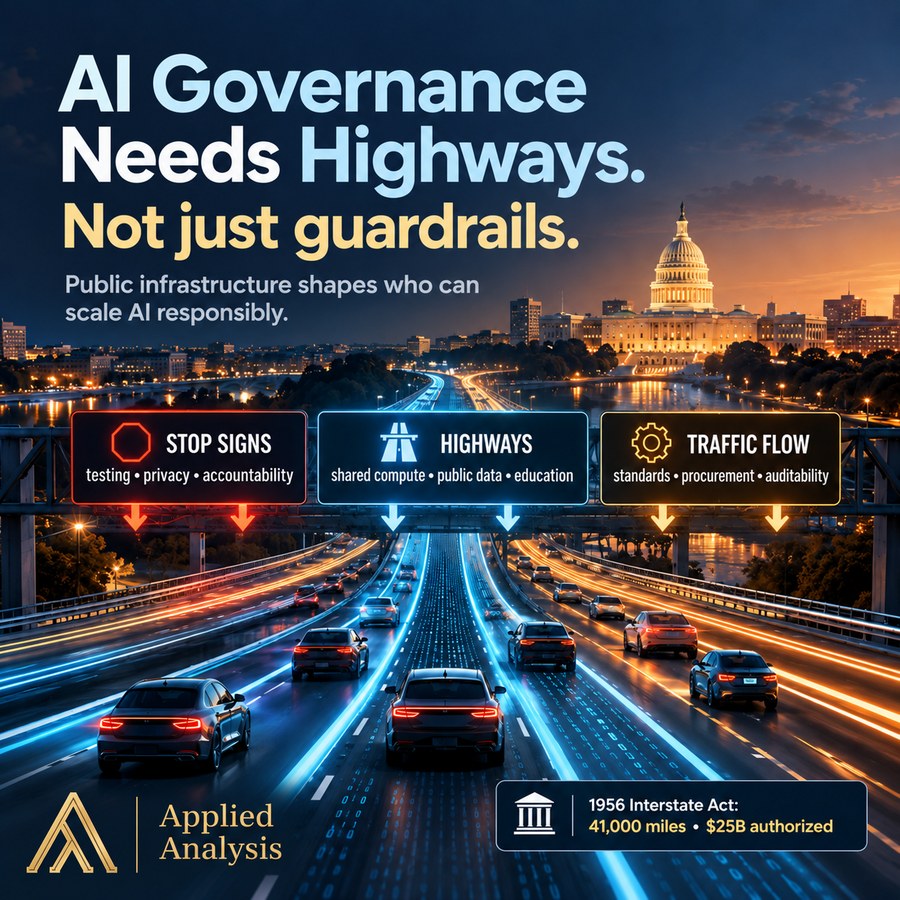
The public conversation around government and AI often collapses into one word: guardrails. That framing is useful, but incomplete. Guardrails keep cars from leaving the road. They do not create the road.
The automobile era offers a better analogy. Government did not only respond to cars by adding stop signs and safety rules. It also helped standardize the traffic-control system, funded roads, and eventually built the interstate highway system that made large-scale mobility possible. Public action created both restraint and capacity.
The effective government role in AI is not just to prevent harm. It is to create the shared infrastructure, standards, and access conditions that let more people and organizations use the technology well.
The automobile lesson is bigger than regulation
The Federal Highway Administration's history of the Manual on Uniform Traffic Control Devices describes how early automobile travel exposed a practical problem: drivers needed visible, consistent signs to move safely and efficiently. The National Archives describes the 1956 National Interstate and Defense Highways Act as authorizing a national highway system and the largest public works project in the country's history.
Those are two different government roles. One is coordination: signs, signals, standards, and rules that reduce chaos. The other is enablement: roads, capacity, connectivity, and public investment that expand what people can do.
AI needs both. A society that only writes prohibitions may reduce some risk but still leave smaller firms, schools, researchers, agencies, and communities without the practical infrastructure to participate. A society that only funds capability without rules may scale harm faster than institutions can respond.
Testing, disclosure, privacy, procurement rules, risk management, and accountability standards help keep high-impact systems from becoming unmanaged hazards.
Shared compute, public datasets, evaluation infrastructure, open standards, education, and access programs help distribute the benefits of AI beyond the largest platform companies.
Markets need common expectations so organizations can build, buy, govern, and audit AI systems without reinventing the road rules in every transaction.
What AI highways look like
Some of this infrastructure already has a shape. NIST's AI Risk Management Framework gives organizations a voluntary structure for incorporating trustworthiness into AI design, development, use, and evaluation. The National Science Foundation's National Artificial Intelligence Research Resource is a more literal capacity play: NSF describes it as scalable national infrastructure that gives the research and education communities access to computing, software, data, models, educational resources, and expertise.
Those are not the same thing, and that is the point. One helps establish shared practice. The other helps broaden access to the materials of innovation. Together they point to a stronger model of public AI policy: safety rules plus productive infrastructure.
- Standards that make responsible AI easier to evaluate and procure.
- Compute and data access that reduce the gap between large incumbents and everyone else.
- Public-sector testbeds where methods can be assessed before they are embedded in high-stakes systems.
- Workforce and education programs that help people use AI rather than merely be affected by it.
- Auditing, measurement, and incident-reporting channels that improve the system over time.
The executive implication
For business leaders, this matters because government will shape the operating environment for AI whether or not a company thinks of itself as regulated. Standards will influence vendor selection. Public infrastructure will change who can compete. Procurement rules will define what "acceptable AI" means in many markets. Workforce programs will affect talent availability. Government data and research access may create new sources of advantage.
The right strategic question is not, "Will government slow AI down?" It is, "Which public rules and public infrastructure will determine where AI can scale responsibly?"
Applied Analysis helps leaders think about that full operating model: opportunity selection, readiness, governance, infrastructure, adoption, and the conditions required to move from scattered AI experiments to durable capability.
Sources: Federal Highway Administration, “The Evolution of MUTCD”; National Archives, “National Interstate and Defense Highways Act (1956)”; NIST, “AI Risk Management Framework”; and U.S. National Science Foundation, “National Artificial Intelligence Research Resource.”